
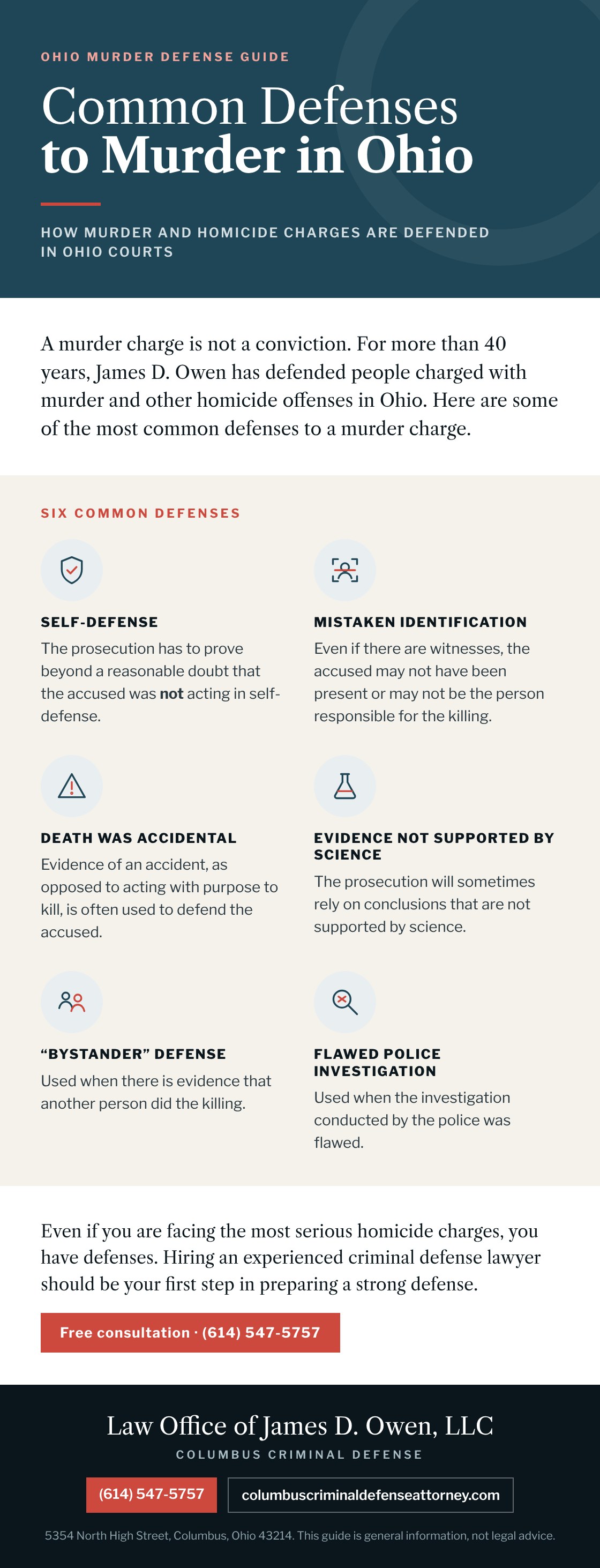
A murder or homicide charge is not automatically a conviction. Over more than four decades defending Ohio’s most serious criminal cases, James D. Owen has developed and refined twelve distinct defense strategies — often combining two or three of them in a single case to build the strongest possible defense.
The 12 Defenses We Use to Win Murder and Homicide Cases
1. Self-Defense or Defense of Another
This defense applies when the accused did cause the death, but was legally justified because they reasonably feared death or serious bodily harm to themselves or someone else. Jeremy Turner was acquitted of Serious Felony Murder and two counts of Involuntary Manslaughter using exactly this defense. Because self-defense involves its own detailed body of Ohio law, it’s covered in full on its own page.
Read our about self-defense in Ohio homicide cases.
2. Alibi Defense or Mistaken Identification
An alibi defense means that the accused was at a place other than where the crime occurred at the time the crime occurred. Under Ohio criminal rule 12.1 the accused in a criminal case who opposed to offer testimony to establish and alibi, must not less than 30 days before trial, in a felony case must file a notice in writing that includes specific information as to the place at which the accused claims to have been at the time of the alleged offense.
False identification is one of the leading causes of wrongful convictions, especially in the chaotic, high-stress aftermath of a homicide. Unduly suggestive police lineups, inaccurate photo identifications, and simple eyewitness error can all lead to the wrong person being charged. This defense has been used successfully in Ohio cases even where the state was seeking the death penalty.
3. The Death Was an Accident
This defense applies when the accused did not purposely cause the death, but rather caused it by accident — meaning an unintentional event without any design or purpose to bring it about. This strategy has led to successful outcomes in two Aggravated Vehicular Homicide cases and one Aggravated Murder case.
4. The State’s Science Doesn’t Hold Up
Forensic evidence is not infallible, and prosecutors sometimes rely on scientific conclusions that don’t hold up to independent scrutiny. In a Portage County, Ohio case, prosecutors believed a truck bedliner contained a murder victim’s blood in the exact location a confidential informant claimed the body had been transported. Independent testing by a retained expert proved the substance was actually human sweat, with DNA too degraded to connect to any specific person.
5. Present But Not Involved (the “Bystander” Defense)
This defense applies when the accused was present at the scene, but someone else present actually caused the death. It was used successfully in the Franklin County, Ohio death penalty murder case of William Berry II, who was found not guilty of all charges after the credibility of the state’s key eyewitness was thoroughly challenged.
6. No Purpose or Knowledge to Cause Death
Similar to the accident defense, this strategy applies in situations where the accused’s actions did cause a death, but without any purpose or knowledge that a death would result — undermining the specific mental state most homicide charges require.
7. A Flawed Police Investigation
A rushed or incomplete police investigation can lead directly to a wrongful charge or conviction. This approach was used to help exonerate Timothy Howard, Gary James, Randy Resh, and Robert Gondor — four men wrongfully convicted of homicides they did not commit.
Read the full story of these exonerations.
8. It Was a Lesser Offense, Not Murder
Sometimes the evidence supports a homicide occurred, just not the one charged. A client identified as Jacob M. was charged with Aggravated Murder and Murder for the shooting death of his wife, but was ultimately convicted only of the lesser offense of Reckless Homicide after the defense argued the shooting was accidental or, at worst, reckless.
9. The Cause, Manner, or Time of Death Is Disputed
This defense challenges the prosecution’s account of how, when, or why a death occurred. It was used successfully in the Aggravated Vehicular Homicide case of Timothy C., and has also been used in a Serious Felony Murder case involving disputed shaken-baby evidence, where retained medical experts concluded the evidence did not support the state’s theory.
10. A False or Coerced Confession
Confessions are not always reliable, particularly when obtained through prolonged or improper interrogation tactics. This defense has been used successfully to obtain a dismissal in an alleged gross sexual imposition case, using experts among the foremost in the country on false confessions.
11. Not Guilty by Reason of Insanity
This defense applies when the accused lacked the mental capacity to understand that their conduct was wrong. It is a difficult defense to win and is used selectively, based on the specific facts and available expert evaluation.
12. Character and Reputation Evidence
Ohio Evidence Rule 404(A)(1) allows an accused to offer evidence of a pertinent character trait, such as a reputation for peacefulness or honesty. This strategy was used successfully in a Franklin County case for a client accused of assaulting a neighbor with a set of brass knuckles; after coworkers testified to the client’s reputation for truthfulness and peacefulness, the jury returned a unanimous not-guilty verdict after a short deliberation.
How These Defenses Work Together in a Real Case
Most winning homicide cases don’t rely on a single defense in isolation — they combine two or three of these strategies to build a complete, believable account of what actually happened. A case built only on “the science doesn’t hold up,” for example, is often strengthened significantly when paired with a mistaken identification argument or a challenge to the police investigation itself.
Because each case is different, no expectations should be made about the results that can be achieved in your case or in any other case. Past performance is not an accurate predictor of future results.